Have you heard about Release Time for Religious Instruction? Maybe you’ve seen the acronym RTRI a few times in the news headlines, and made a mental note to look into it, and then you know… life.
Release Time for Religious Instruction (RTRI) has made its way to North Carolina, and we’re sounding the alarm bells! Here is a comprehensive guide to RTRI in NC and actual, tangible steps to fight it, so we can keep public schools safe for students of all faiths and none.
What is RTRI?
RTRI programs like LifeWise Academy take public school students off school grounds during class time to attend Bible lessons. Previous attempts to pass RTRI legislation on its own failed. However, the GOP was able to sneak this provision into the NC budget in July 2026.
The law now requires every school district and charter school in NC to write a policy for RTRI, allowing students to leave school for 1 to 4 hours a week for off-site religious instruction. That’s approximately 39 to 156 hours a year, depending on the district(!?!). Wake and Durham County school boards have opted for the minimum of 1-hour per week, and can not take away from instructional time (more below).
What does the law say about religious instruction and how is this different?
NC teachers are only allowed to discuss religion in a non-devotional way such as literature and history. Under the new law, students are allowed to miss class for religious instruction with a parent or guardian’s written consent. The instruction cannot take place on public school property nor use state or local funds, and must be provided by a private entity.
So….. if no state or local funds can be used for the religious instruction, and it must be provided by a private entity, where is the money coming from to fund these programs?
LifeWise and the Paper (money) Trail
LifeWise Academy, an Ohio-based organization, is one of the most well-funded RTRI programs in the US. It is making a concerted effort to open over 100 locations in NC during the 2026-2027 school year. They partner with Project 2025 organizations and other extremist groups that aim to dismantle public education, including the National Christian Foundation, The Heritage Foundation, Family Research Council, and Moms for Liberty. In 2024, LifeWise raised $35 million; only 24% was spent on teaching students. That makes me wonder where the remaining funds are being spent and who the wealthy donors hiding behind the foundation are? This money is not local, and the funding is not transparent!
LifeWise’s explicit goal is to target “unchurched students in public schools with the gospel”. They focus on the youngest children with 80% of its participants between 6 and 11 years old. Kids are often sent back to school with candy, toys, and business cards to hand out. They’re also given promises of rewards like pizza parties or ice cream parties for getting classmates to join. No child wants to feel “left out”, and the pressure to attend is intense, especially for minority faiths or nonreligious students.
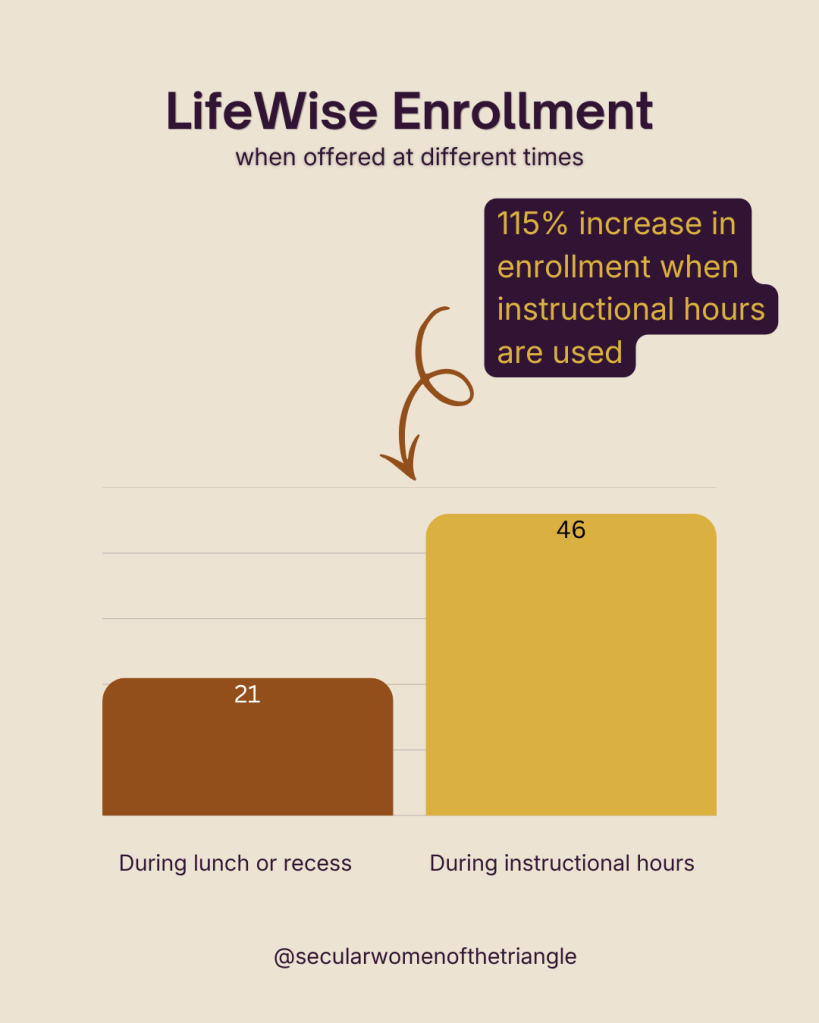
Oftentimes, the programs will start by being held during lunch or recess, but don’t be fooled! LifeWise’s ultimate goal is to take away from actual class time. They know that there is 115% growth when instructional time is used. They’ll start with lunch or recess, and then push into classroom time, because that’s the only way their enrollment really multiplies. This is a common tactic of White Christian Nationalists… they start with something small as a way to get their foot in the door, and then they slowly chip away at our right and freedom.
Source for LifeWise stats in above section
Why is this a problem?
You may be thinking “just don’t send your kids there. No big deal, right?” WRONG. That ignores the impact on everyone else like loss of instruction time, cuts to electives and specials when attendance drops, and increased bullying of people from different backgrounds– to name just a few reasons.
Loss of Instruction Time
Our teachers are already stretched and resources are already limited. Kids who stay behind are often given busy work or are idle. RTRI programs often fail to offer accommodations for students with IEPs, 504 plans, or disabilities. And those students removed from class are missing their IEP/504 services from qualified professionals, leading to potentially delaying progress toward their educational goals.
When students do return to school, it is disruptive to the whole class. A staff member has to step out of the classroom to collect the students, and typically 8-15 minutes are lost during transitions. Teachers need to reexplain the instructions or reteach part of a lesson, taking away instructional time from students who did not miss class.
Learning is cumulative and missing class leads to compounding gaps. For example, your child misses a small phonics lesson, and the next day’s writing assignment requires writing out that sound pattern. Imagine what happens when that occurs weekly. And what does that compounding gap look like quarterly?
LifeWise may teach your child beliefs that your own pastor rejects if you are a person of faith.
LifeWise uses a Southern Baptist Convention branded curriculum that teaches distinctive doctrines on salvation, creation, gender roles, sexuality, and church-state (often dominionist in tone) and is presented as the only Christian view.
Are you a mom living with your partner unmarried? LifeWise teaches your child and peers that you are living in sin. Are you LGBTQIA+ or an ally? LifeWise teaches that “God made us male or female”, erasing transgender and non-binary folks, fueling misgendering and exclusion. That’s not character education; it’s moral surveillance of women and erasure of gender-diverse kids.
“They take it away from electives”:
Electives are important life skills! Skipping electives for RTRI means missed experiences and missed practice times. For example, when a child misses a skill day from PE that could result in a lower assessment, create safety concerns in later units, or affect motor-skill progressions. When your child misses sectionals for band, that can lead to a shaky concert and your kiddo losing public-performance confidence.
As participation drops, admin later cuts these electives due to low enrollment. Removing these electives is unfair to kids who do not attend Lifewise.
These examples just skim the surface of problems that LifeWise creates in public schools.
For a more in-depth look at the problems with LifeWise curriculum, view this resource from Secular Education Association.
Whether you’re concerned about academic integrity, arts and athletics, disability rights, religious freedom, student safety, or simple fairness– or all of the above– every one of these is an important reason to keep public-school time for public education.
Bringing you up to speed on RTRI in Wake and Durham Counties!
In September 2026, Wake County School Board held its final vote on their policy, opting for the least disruptive option of 1-hour a week, in a 6-1 vote. Several members commented that they did so reluctantly in order to comply with the law. Jennifer Job was the only school board member to vote against. So, thank you, Jennifer! a constitutional gold star for you! Wing Ng and Toshiba Rice were not present for the vote.
Cheryl Caulfield voted yes enthusiastically and proudly discussed her ties with Lifewise. She stated that she’s been in direct contact with LifeWise’s diretor and is working with them to find the best timing for their programs, aiming to schedule “around specials and electives, never during core instruction”. Caulfield spoke highly of LifeWise and was quoted saying “This is a very positive program for our students,” Caulfield said.
Durham County and Orange County School Boards passed their policies, also allowing the minimum of 1 hour per week. Wake, Durham, and Orange counties have all included provisions in their policies that the 1-hour must include travel time, prohibiting public support or academic credit, and requiring parental request. Orange and Durham county included that students cannot miss core subjects or testing for RTRI; and Durham included that public school staff are to remain neutral.
LifeWise is currently in the process of establising 44 locations in Wake County at the time of writing (11/3/26) according to Respect Public Schools Tracker and 51 locations in Durham County. Efforts in Orange County and Chapel Hill-Carborro Schools have been slow, but the effort is there!
Is your school on the list? Then keep reading and see what steps you need to take to protect our private schools!
So, what are actual, tangible action items that you can do?
Secular Education Association (SEA) provides some amazing step-by-step guides to help you get started!
Get informed, stay informed, and share that information.
Congrats, you are doing it! Check out our resources, sources, and partners to stay informed. Oh, and share this please!
Encourage your faith leaders/clergy to sign this letter:
Pastors for NC Children invites clergy and faith leaders to sign their letter of support. If you’re religious, please talk to your faith leaders about this policy. If you’re non-religious, talk to your friends and family about RTRI and encourage them to approach their faith leaders.
Monitor your school district:
Take a deep breath and check out Secular Education Association’s Map and Respect Public Schools Tracker to see what RTRI programs are popping up near you. Check back frequently, keep your friends updated, and budget in the self-care, because we’re in this fight for the long run!
If your school board is considering a policy,
Petition your school board and insist on safeguards: As recommended by SEA, insist on the following safeguards:
- Release-time classes do not take place on school grounds.
- No public funds are expended in support of release-time programs.
- Schools do no more than accommodate student schedules.
- School officials do not promote the program or coerce students to attend.
- Coercion does not just mean school employees forcing or telling students to attend; it can also be giving students who don’t attend extra assignments or study hall that could be viewed as punishment for non-attendance.
- No credit for release time.
- Public schools must not provide any logistical support beyond accommodating schedules, including providing transportation to the release-time programs.
Additionally, be sure to provide your school board with some model policy. Here are two examples from Secular Education Association and Respect Public Schools
If LifeWise is already in your school district,
From Secular Education Association:
- Continue to request revisions to your board’s policy until safeguards are in place.
- Be aware of potential violations. Watch for them, document them, and report them to:
- Secular Education Association so we can add them to our archive.
- Your school principal, superintendent, and Board of Education (BOE)
- The state department with oversight over school principal, superintendent, and staff
- Note that oversight over BOE is limited
- Voters
- State ethics commission for financial conflicts of interest
- In extreme situations, board members may be removed
- The state Attorney General (even though it may be ignored)
- Your state and local representatives
- Lawsuits are a possibility, but creating a bad precedent is a concern.
- Enforce other violations (ethical, professional responsibility, etc.).
3. Don’t be shut up about it. Attend meetings. Be annoying (you’re not, I promise). These are YOUR taxes and YOUR kids’ education at stake. Make your voice heard!
Organizations and Resources:
Local
Secular Women of the Triangle, duh. Triangle Freethought Society, Eno River Unitarian Universalists, Triangle Area Christians Against Christian Nationalism, Pastors for NC Children and their affiliate People of Faith For Public Schools
National
Americans United, Secular Education Association, Respect Public Schools, Freedom From Religion Foundation, American Atheists, Honesty for Ohio’s RTRI Toolkit
Sources:
WUNC: WCPSS advances policy to let students leave school for religion classes, to comply with state law
ABC11: Wake school board approves religious instruction policy
N&O: Religious instruction, public schools and the NC budget: 5 things to know
N&O: Why Wake is unhappy it has to let students miss school for religious instruction
WRAL: Wake school board moves forward with policy allowing excused absences for religious instruction
WRAL: Wake school board approves religious instruction absences, new book challenge process
Stay in Touch
Although this post is long, it only scratches the surface of the harm RTRI programs cause in public schools. Check back frequently to learn more about what you can do about RTRI, what questions to ask your school board, and what steps Secular Women of the Triangle and our partners are taking to protect public schools!


Leave a Reply