
“I would love to see the group have a book club!” one of our members exclaimed at our first community meeting, her enthusiasm lighting up the room. I felt myself fill up with excitement yet again, as I often do when I think about the future and the big plans that I have for our group. I glanced around our table to see a round of smiles confirming that I wasn’t the only one excited about this idea. I scribbled “book club” down on my legal pad next to the other scribbles of big ideas. Later when I got home, I deciphered my notes from earlier and made my to-do list. At the top, I wrote “Start book club”.
And at the top, it waited for its turn. And then one day, after a couple months of waiting for proper attention, I was ready to get the planning started. We discussed a few locations and found a local conference room which would offer privacy for a group of 12. “Twelve seats seemed like plenty,” I thought confidently.
Our next decision: the book! We offered up a few suggestions– all of them made it to my Goodreads list! Last year, I challenged myself to dive into literature that explored secularism, Christian nationalism, and non-belief. Triangle Freethought Society, our local branch of Freedom From Religion Foundation and an affiliate of the American Humanist Association and American Atheists, invited Kate Cohen to speak about her book We of Little Faith:Why I Stopped Pretending to Believe (and Maybe You Should Too) in January 2024. I found her writing witty and approachable, and the book encouraged me to be more open about my atheism. To my delight, the group voted to make that our first book.
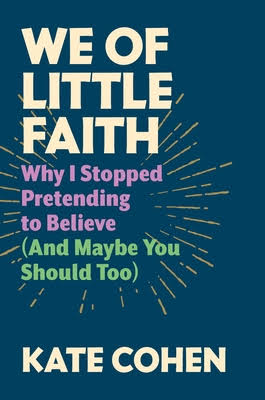
We had a location and a book. There was only one problem… We immediately met the 12 person limit, and we had 17 RSVPs(!!!) at that time. We hated the idea of someone investing the time in reading a book, and not having the opportunity to discuss it, so we needed to find a bigger space. After a morning of getting very familiar with the City of Raleigh’s rentals we decided to move to a community center meeting room, and then we had our next, but most important challenge– how do we maintain emotional intimacy with a group size so large?
After brainstorming together, we found a way to maintain the intimacy of our discussion, even with a larger group. Our longtime members would lead smaller breakout groups, and during the final 30 minutes of our book club, we’d come back together as a whole group to create something together. Our members have expressed a desire to create new rituals and traditions since leaving the faith. In We of Little Faith, Cohen provides a formula for creating your own holiday. Inspired by Kate Cohen’s formula for crafting your own holiday in We of Little Faith, we decided to wrap up our discussions by creating a unique holiday for SWT—a celebration all our own.
As we read the book, our members shared possible discussion questions. We ended up with a huge list and narrowed it down for the book club– honestly, we had so much to discuss at our event that we barely made it through our finalized question list. Below are all the discussion questions that the group created– we had plenty, and we narrowed them down significantly. We hope that you will be able to use them for your own book club or personal reflection.
Curious about what sparked the most lively debates? Download our Discussion Question List and see which topics made the final list and had us chatting all afternoon!
- What pushed your “activation button” for you to decide to move away from religious beliefs, or affirm your conviction to stay away from them if you never initially had religious beliefs.
- In what ways did you/did you not connect to the author’s life story?
- What is something new you learned from this book or an “aha” moment you experienced while reading?
- Cohen urges readers to embrace the title atheist over other titles such as agnostic, humanist, skeptic, or free thinker. What label(s) do you use to describe your lack of beliefs and why? Have these labels changed over time? If so, how and what caused the change?
- Cohen encourages readers to be forthright about their lack of beliefs. Are you “out” as an atheist? Does your openness vary with different groups such as family, friends, coworkers, and neighbors? If you’re not open, what’s holding you back? If you are open, what kind of reception have you received?
- Cohen separates the cultural practices of religion such as celebrating holidays and enjoying religious art and music from belief in a higher power. Do you participate in culturally religious activities? Do you celebrate religious holidays such as Christmas? Have you attempted to make such holidays more secular? Have you found your own secular holidays to celebrate? Or do the religious trappings not bother you?
- What rituals or practices have you incorporated into your life to create moments of reflection or mindfulness, similar to how prayer or structured rituals like the Ignatian Examen or “Rose, Bud, Thorn” can provide? (p. 146)
- Parenthood often leads people back to familiar religious traditions for community, values, and guidance on life’s big questions. (p. 14) Have you noticed friends or family members re-engage with religion after having children? For our members who are mothers, did becoming a parent influence or challenge your lack of religious faith in any way?
- p 28. Cohen recalls coming out as an atheist for the first time to someone outside her family, only to hear, “I’ve never met an atheist.” She then reflects that she likely wasn’t the first atheist this person had encountered—just the first to admit it. Have you had a similar experience where people assume you are the only non-believer they’ve met? If you come from a more religious background, what was your experience when you encountered an atheist out in the wild? lol
- In the chapter “Take Me to Church,” Cohen reflects on a challenge for non-believers: the absence of a “second home” that inspires wonder and awe—a space where, simply by showing up and belonging, one feels connected to something greater, filled with grace, beauty, history, and community(p. 120). As a secular woman, what spaces or experiences provide you with that sense of belonging and inspiration?
- Have you ever found yourself using the term “agnostic” instead of “atheist” because you felt it would be more positively received? In what ways have you tried to “rebrand” your lack of faith to make it more palpable to others? (p. 30 Ch: Why I Don’t Call Myself Agnostic)
- In the chapter “I’m Sorry, Honey, God is Just Pretend,” (p. 38) Cohen reflects on her experiences as a mother navigating questions about the existence of God. She also shares responses from other secular authors on how they’ve approached this challenging topic. Have you ever had a child ask you a similarly complex or loaded question? How did you respond, and what thoughts or emotions did it evoke for you?
- Cohen reflects, “To what extent, precisely, do I let my children make up their own minds about life? What lessons do I teach, and what do I refrain from teaching, lest I influence them too much?” For those who had a religious upbringing, how much influence did your family have on your religious beliefs? Did you feel like you had the agency to make up your own mind about life and your beliefs?
- On page 50, Cohen introduces her “Truth Spectrum,” which categorizes beliefs as “Literally True,” “Mostly True,” “There is truth in this,” “I can use this to make truth,” and “Bullshit.” How does your own religious journey align with this spectrum? Reflect on where your past beliefs or experiences might fall within these categories and share with the group.
- In the chapter “Life with No After” (p. 57), Cohen explores profound topics such as death and the meaning of life, presenting various perspectives. She references Epicurus’ notion that “death is the deprivation of sensation” (p. 66) and the philosopher Setiya’s argument that the key to living in the face of life’s inevitable end lies in blending the telic (goal-oriented) and atelic (non-goal-oriented) aspects of life—finding joy in the journey, not just in achieving the goal (p. 72). What secular philosophies, literature, or ideas have offered you comfort or insights when grappling with these challenging questions?
- In the chapter “How to Start Your Own Holiday”, Cohen reflects on celebrating religious holidays despite not believing in their associated faiths, describing it as hearing “the distant beat of music” or watching “two people in love” (p. 83)—a partial but not complete experience. Do you feel that leaving faith has impacted your ability to fully embrace the holiday spirit? How has your relationship with major religious holidays evolved since stepping away from faith?
- Have you ever created your own secular holiday? If so, which elements of Cohen’s formula for crafting a personal holiday (outlined on p. 86) did you incorporate into your celebration?
- Using Cohen’s formula for creating your own holiday (outlined on p. 86), is there a holiday our discussion group would like to create together? What themes, rituals, or traditions would make it meaningful to us?
- In the chapter “How Will We Know Right from Wrong?” (p. 95), Cohen explores the connection between morality and religion, questioning the presumption that belief in God is necessary for moral behavior. As a secular woman, where do you believe morality originates, and what shapes your sense of right and wrong?
- In “How Will We Know Right from Wrong?”, Cohen argues that religion doesn’t shape our values but rather we bring our values to religion, as people often “pick the parts of the religious tradition that suit their values. (p. 102)” As secular women, what values matter most to you, and how have they evolved throughout your journey away from religion or within a secular framework? What keeps you from committing a daily secular crime spree?
- Cohen highlights the frequent use of prayer—often sectarian—before ceremonial procedures like legislative sessions to set the tone (p. 132-4). As secular women, how do you feel when you find yourself in situations where this occurs? Have your feelings or reactions to these moments changed over time, or at different points in your journey as a secular person?
- Cohen explores how prayer and religion often provide explanations for feelings of transcendence and offer comfort during challenging times (p 142-148). What rituals, routines, or practices have you incorporated into your life to foster a sense of transcendence or find comfort during difficult moments?
- In the chapter Rite of Passage, Cohen discusses various rites rooted in religious traditions like bat mitzvahs and wedding ceremonies. She presents different approaches non-believers can take, including “Option 1: Participate outwardly but not inwardly” (p. 153), “Option 2: Participate, but with caveats” (p. 156), and “Option 3: Just Say No.” How has your approach to participating in religious or culturally rooted rites evolved throughout your (non-)religious journey?
- In the chapter Rite of Passage, Cohen reflects on reaching a point where, after consistently setting boundaries and sitting with others’ discomfort, she crossed a threshold where her new reality became accepted. She quotes van Gennep, “The magic circle is broken for the first time and, for the individual, it can never again be completely closed” (p. 168), signifying a permanent shift in expectations and relationships.
Have you ever experienced a similar moment—where setting boundaries led to a lasting change in how others interacted with you or what they expected of you? How did it feel to cross that threshold, and what impact did it have on your relationships or sense of self? - In the chapter Unplugging from the Higher Power, Cohen recounts attending an AA meeting with a friend and reflecting on the program’s reliance on the concept of a “Higher Power (p. 169-72).” While many find AA’s 12-step program transformative, its faith-based language—6 of the 12 steps reference a “Higher Power”—can pose challenges for some non-believers. Some atheists and non-believers adapt by redefining “Higher Power” in a way that resonates with them, while others struggle to connect with such concepts.
Have you encountered programs, groups, or systems in your life that are centered around faith? How do you personally navigate references to a “Higher Power”? Are you able to reinterpret the language to find meaning, or do you find it difficult to connect with frameworks that others might find helpful? - Cohen critiques the phrase “thoughts and prayers,” (p. 180-182) particularly in the context of tragedies like school shootings, arguing that it often replaces meaningful action. She points to countries like Australia, New Zealand, Norway, and England as examples of places that have successfully reduced gun violence through policy changes. How do you interpret her assertion that belief in God can sometimes allow people to “shirk their very real responsibilities to one another”? Do you think cultural or religious beliefs in the U.S. have influenced the way we respond to tragedies? How might we, as a community, move beyond symbolic gestures to foster real action and responsibility in the face of preventable tragedies?
- In the epilogue, Cohen explores the public perception of atheists, highlighting the stigma associated with openly identifying as one. She compares this to the prejudice faced by vegans, homosexuals, and other groups with concealable stigmatized identities(p. 190), and she argues that openness about atheism can help challenge and break this stigma. How do you feel about Cohen’s argument that being openly atheist can reduce prejudice? Do you agree that visibility plays a key role in changing public perception? Have you personally experienced or witnessed stigma related to atheism? How have you navigated these situations? What parallels do you see between the challenges faced by atheists and other groups with concealable stigmatized identities?
If you feel inspired by any of these questions, feel free to let us know you thoughts in the comments! Stay tuned for community updates. 😊
Featured Photo by Seven Shooter on Unsplash


Leave a Reply